When Did the Rebels Get Control Over New York Again
The Battle of Long Island, also known as the Battle of Brooklyn and the Battle of Brooklyn Heights, was an action of the American Revolutionary War fought on Tuesday, August 27, 1776, at the western border of Long Island in the present-day Brooklyn, New York. The British defeated the Americans and gained access to the strategically important Port of New York, which they held for the residual of the war. Information technology was the first major battle to take place after the United States declared its independence on July iv, and in troop deployment and gainsay, it was the largest battle of the war.
Afterwards defeating the British in the siege of Boston on March 17, commander-in-chief George Washington relocated the Continental Army to defend the port metropolis of New York, located at the southern end of Manhattan Island. Washington understood that the city's harbor would provide an first-class base for the Majestic Navy, then he established defenses in that location and waited for the British to attack. In July, the British, under the command of General William Howe, landed a few miles beyond the harbor on the sparsely populated Staten Isle, where they were reinforced by a fleet of ships in Lower New York Bay over the next month and a half, bringing their total forcefulness to 32,000 troops. Washington knew the difficulty in property the city with the British armada in command of the entrance to the harbor at the Narrows, and accordingly moved the bulk of his forces to Manhattan, believing that it would exist the commencement target.
On August 21, the British landed on the shores of Gravesend Bay in southwest Kings Canton, beyond the Narrows from Staten Island and more than than a dozen miles south of the established East River crossings to Manhattan. After v days of waiting, the British attacked the American defenses on the Guan Heights. Unknown to the Americans, however, Howe had brought his main army effectually their rear and attacked their flank soon after. The Americans panicked, resulting in 20 percent losses through casualties and capture, although a stand by 400 Maryland and Delaware troops prevented greater losses. The balance of the regular army retreated to the main defenses on Brooklyn Heights. The British dug in for a siege, but on the night of August 29–30, Washington evacuated the entire ground forces to Manhattan without the loss of supplies or a single life. The Continental Army was driven out of New York entirely afterwards several more defeats and was forced to retreat through New Jersey to Pennsylvania.
Prelude to battle [edit]
In the first phase of the state of war, the British Army was trapped in the peninsular metropolis of Boston and were forced to carelessness it on March 17, sailing to Halifax, Nova Scotia, to await reinforcements.[7] Washington so began to transfer regiments to New York Metropolis, which he believed the British would set on next because of the port'south strategic importance.[viii] [9] Washington left Boston on Apr 4, arrived at New York on Apr thirteen,[ten] and established headquarters at the former home of Archibald Kennedy on Broadway facing Bowling Green. Washington had sent his second-in-command Charles Lee alee to New York the previous February to found the urban center'due south defenses.[11]
Lee remained in New York Urban center until March, when the Continental Congress sent him to South Carolina; structure of the city's defenses was left to General William Alexander (Lord Stirling).[10] Troops were in limited supply, so Washington plant the defenses incomplete,[12] only Lee had concluded that in whatever case it would be impossible to concord the city with the British commanding the body of water. He reasoned that the defenses should be located with the power to inflict heavy casualties upon the British if any movement was made to take and hold ground.[11] Barricades and redoubts were established in and around the metropolis, and the bastion of Fort Stirling was built across the East River in Brooklyn Heights, facing the city.[13] Lee had also seen to it that the firsthand area was cleared of Loyalists.[fourteen]
Strategy [edit]

American strategy chosen for the first line of defence force to be based on the Heights of Guan, a series of hills which stretched northeast beyond King's County. The main defensive works were a series of forts and entrenchments located in the northwest of the canton, in and effectually Brooklyn. The "Road to Narrows" is the Gowanus Route. No. 5 is the "Old Stone House". Map by Bernard Ratzer based on his 1766–1767 survey.
Washington began moving troops to Brooklyn in early on May,[15] and in that location were several thousand of them there in a short time. 3 more than forts were under structure on the eastern side of the Eastward River to support Fort Stirling, which stood to the west of the hamlet of Brooklyn Heights. These new fortifications were Fort Putnam,[16] Fort Greene,[16] and Fort Box[16] (named for Major Daniel Box).[17] They lay from north to south, with Fort Putnam uttermost to the n, Greene slightly to the southwest, and Box slightly farther southwest. Each of these defensive structures was surrounded by a big ditch, all continued by a line of entrenchments and a full of 36 cannons.[18]
Fort Defiance was also beingness constructed at this time, located further southwest, past Fort Box, well-nigh nowadays-day Cherry-red Hook.[17] In addition to these new forts, a mounted battery was established on Governors Island, on Manhattan cannons were placed at Fort George facing Bowling Greenish, and more cannons were placed at the Whitehall Dock, which saturday on the Eastward River.[19] Hulks were sunk at strategic locations to deter the British from inbound the East River and other waterways.[20]
Washington had been authorized by Congress to recruit an army of upwards to 28,501 troops, just he had only 19,000 when he reached New York.[21] Armed forces discipline was inadequate; routine orders were non carried out, muskets were fired in camp, flints were ruined, bayonets were used as knives to cut food, and firearm readiness was lax.[22] Fiddling internal conflict was common nether the strain of a big number of people from different environments and temperaments living in relative shut proximity.[23]
Commander of the artillery Henry Knox persuaded Washington to transfer 400 to 500 soldiers, who lacked muskets or guns, to coiffure the arms.[19] In early June, Knox and General Nathanael Greene inspected the state at the north terminate of Manhattan and decided to establish Fort Washington. Fort Constitution, afterward renamed Fort Lee, was planned opposite Fort Washington on the Hudson River.[nineteen] The forts were intended to discourage the British ships from sailing up the Hudson River.[19]
British arrival [edit]


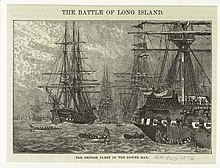
The British fleet in the lower bay (Harpers Magazine, 1876) depicts the British fleet amassing off the shores of Staten Island in the summer of 1776
On June 28, Washington learned that the British fleet had ready canvas from Halifax on June 9 and were heading toward New York.[24] On June 29, signals were sent from men stationed on Staten Island, indicating that the British fleet had appeared. Within a few hours, 45 British ships dropped anchor in Lower New York Bay.[25] The population of New York went into panic at the sight of the British ships; alarms went off and troops immediately rushed to their posts.[25] Less than a calendar week later, there were 130 ships off Staten Island nether the command of Richard Howe, the brother of Full general Howe.[26] On July two, British troops began to land on Staten Isle. The Continental regulars on the isle took a few shots at them before fleeing, and the citizens' militia switched over to the British side.[26]
On July 6, news reached New York that Congress had voted for independence four days before.[27] On Tuesday, July 9, at 18:00, Washington had several brigades march onto the commons of the city to hear the Announcement of Independence read. After the end of the reading, a mob ran downwardly to Bowling Green with ropes and confined, where they tore downwards the gilt lead equestrian statue of George 3 of Cracking Britain.[28] In their fury, the crowd cutting off the statue's caput, severed the olfactory organ, mounted what remained of the head on a fasten outside a tavern, and the rest of the statue was dragged to Connecticut and melted downwardly into musket balls.[29]
On July 12, the British ships Phoenix and Rose sailed upwardly the harbor toward the mouth of the Hudson.[29] The American batteries opened burn from the harbor defenses of Fort George, Fort Defiance, and Governors Isle, but the British returned fire into the city. The ships sailed along the New Bailiwick of jersey shore and continued up the Hudson, sailing by Fort Washington and arriving by nightfall at Tarrytown, the widest part of the Hudson.[xxx] The goals of the British ships were to cut off American supplies from New England and the north, and to encourage Loyalist support. The only casualties of the mean solar day were 6 Americans who were killed when their own cannon blew upward.[30]
The next twenty-four hour period, July 13, Howe attempted to open negotiations with the Americans.[31] He sent a letter to Washington delivered by Lieutenant Philip Brown, who arrived under a flag of truce. The alphabetic character was addressed "George Washington, Esq."[31] Brown was met by Joseph Reed, who had hurried to the waterfront on Washington's orders, accompanied by Henry Knox and Samuel Webb. Washington asked his officers whether information technology should be received or not, as it did non recognize his rank as general, and they unanimously said no.[32] Reed told Brown that there was no one in the ground forces with that address. On July 16, Howe tried again, this time with the address "George Washington, Esq., etc., etc.", simply it was again declined.[33] The next mean solar day, Howe sent Captain Nisbet Balfour to inquire if Washington would see with Howe's adjutant face up to confront, and a coming together was scheduled for July 20.[33] Howe'south adjutant was Colonel James Patterson. Patterson told Washington that Howe had come with powers to grant pardons, but Washington said, "Those who accept committed no mistake desire no pardon."[33] Patterson departed presently afterward.[33] Washington's operation during the meeting was praised in parts of the colonies.[34]

British troops in the type of apartment-bottomed boat used for the invasion of Long Island. Hessians in their bluish uniforms are in the ii boats that are only partly visible.
Meanwhile, British ships continued to arrive.[35] On August 1, 45 ships arrived with generals Henry Clinton and Charles Cornwallis, forth with iii,000 troops. By Baronial 12, 3,000 more than British troops and some other eight,000 Hessians had arrived.[36] At this betoken, the British fleet numbered over 400 ships, including 73 war ships, and 32,000 troops were camped on Staten Isle. Faced with this large force, Washington was unsure as to where the British would set on.[37] Both Greene and Reed thought that the British would attack Long Isle, but Washington felt that a British attack on Long Island might exist a diversion for the main attack on Manhattan. He broke his army in half, stationing half of information technology on Manhattan, and the other one-half on Long Isle; the army on Long Island was commanded by Greene.[37] On August 20, Greene became sick and was forced to move to a business firm in Manhattan where he rested to recover. John Sullivan was placed in control until Greene was well enough to resume command.[38]

Denyse'southward Ferry, the first identify at which the Hessians and British landed on Long Island August 22, 1776 by A. Brown. This high point overlooking the Narrows was an American arms position and was bombarded by the British before the invasion, but the actual landing took place farther e at Gravesend Bay (around to the left from the perspective of this illustration) where the conditions were more favorable for the minor British boats conveying the troops.
Invasion of Long Island [edit]
At 05:x on Baronial 22, an advance guard of 4,000 British troops left Staten Isle under the command of Clinton and Cornwallis to land on Long Island.[39] At 08:00, all 4,000 troops landed unopposed on the shore of Gravesend Bay. Colonel Edward Paw's Pennsylvanian riflemen had been stationed on the shore, but they did not oppose the landings and savage back, killing cattle and called-for farmhouses on the fashion.[xl] By noon, 15,000 troops had landed on shore along with 40 pieces of artillery, as hundreds of Loyalists came to greet the British troops. Cornwallis pushed on with the accelerate guard, advancing half dozen miles onto the island and establishing a camp at the village of Flatbush. He was given orders to advance no further.[xl] [41]

British military map from 1776 showing the marching routes and date sites during the Battle of Long Island
Washington received discussion of the landings the same day, but was informed that the number was 8,000 to nine,000 troops.[42] This convinced him that it was the feint which he had predicted and therefore he only sent ane,500 more troops to Brooklyn, bringing the full number of troops on Long Island to six,000. On August 24, Washington replaced Sullivan with Israel Putnam who allowable the troops on Long Island.[43] Putnam arrived on Long Island the next day along with six battalions. Likewise that mean solar day, the British troops on Long Isle received 5,000 Hessian reinforcements, bringing their total to 20,000.[44] There was picayune fighting on the days immediately afterwards the landing, although some small skirmishes did take place with American marksmen armed with rifles picking off British troops from time to time.[45]
The American plan was for Putnam to direct the defenses from Brooklyn Heights, while Sullivan and Stirling and their troops would be stationed on the Guan Heights.[46] [47] The Guan (hills) were up to 150 feet high and blocked the most direct road to Brooklyn Heights.[46] [47] Washington believed that, by stationing men on the heights, heavy casualties could exist inflicted on the British earlier the troops fell dorsum to the main defenses at Brooklyn Heights.[48] There were three main passes through the heights; the Gowanus Road farthest to the west, the Flatbush Route slightly farther to the eastward, in the center of the American line where it was expected that the British would set on, and the Bedford Road farthest to the e. Stirling was responsible for defending the Gowanus Route with 500 men, and Sullivan was to defend the Flatbush and Bedford roads where there were ane,000 and 800 men respectively.[46] Six-chiliad troops were to remain behind at Brooklyn Heights. There was one lesser-known path through the heights farther to the east chosen the Jamaica Pass, which was patrolled by merely five militia officers on horses.[49]
On the British side, General Clinton learned of the almost undefended Jamaica Pass from local Loyalists.[50] He drew up a plan and gave information technology to William Erskine to propose to Howe. Clinton's plan had the main ground forces making a night march and going through the Jamaica Pass to turn the American flank, while other troops would continue the Americans busy in forepart.[51] On Baronial 26, Clinton received give-and-take from Howe that the plan would be used, and that Clinton was to command the accelerate guard of the main army of ten,000 men on the march through the Jamaica Pass. While they fabricated the night march, General James Grant's British troops along with some Hessians, a total of 4,000 men, were to attack the Americans in front to distract them from the principal ground forces coming on their flank.[51] Howe told Clinton to be ready to move out that night, Baronial 26.[51]
Boxing [edit]
Night march [edit]

Howard's Tavern every bit information technology appeared in 1776; it was demolished in 1880. The tavern was located about the present-day intersection of Fulton Street and Jamaica Avenue.
At 21:00, the British moved out.[52] No one except the commanders knew of the program. Clinton led a crack brigade of light infantry with fixed bayonets in front, followed by Cornwallis who had eight battalions and xiv artillery pieces. Cornwallis was followed by Howe and Hugh Percy with six battalions, more artillery, and baggage.[52] The column consisted of x,000 men who stretched out over 2 miles. Iii Loyalist farmers led the column toward the Jamaica Pass. The British had left their campfires burning to deceive the Americans into thinking that nothing was happening.[52] The column headed northeast until information technology reached what later became the village of New Lots, when it headed directly due north toward the heights.
The column had still to run into any American troops when they reached Howard's Tavern (also known as "Howard's Half-Way House"), just a few hundred yards from the Jamaica Laissez passer.[53] Tavern keeper William Howard and his son William Jr. were forced to act as guides to show the British the style to the Rockaway Human foot Path, an old Indian trail that skirted the Jamaica Pass to the westward (located today in the Cemetery of the Evergreens). William Howard Jr. describes coming together Howe:
Information technology was well-nigh two in the morning of August 27 that I was awakened by seeing a soldier at the side of my bed. I got upwards and dressed and went down to the barroom, where I saw my father standing in one corner with three British soldiers before him with muskets and bayonets fixed. The army was then lying in the field in front of the house... General Howe and another officer were in the barroom. General Howe wore a camlet cloak over his regimentals. Subsequently asking for a glass of liquor from the bar, which was given him, he entered into familiar conversation with my father, and among other things said, "I must accept some one of yous to prove me over the Rockaway Path effectually the laissez passer." My father replied, "We belong to the other side, General, and can't serve yous against our duty." Full general Howe replied, "That is alright; stick to your land, or stick to your principles, but Howard, you are my prisoner and must guide my men over the hill." My begetter made some further objection, but was silenced by the general, who said, "Y'all have no culling. If you lot refuse I shall shoot you through the head.

Five minutes after leaving the tavern, the five American militia officers stationed at the pass were captured without a shot fired, every bit they thought that the British were Americans.[55] Clinton interrogated the men and they informed him that they were the just troops guarding the laissez passer. Past dawn, the British were through the pass and stopped so that the troops could balance.[55] At 09:00, they fired ii heavy cannons to betoken the Hessian troops below Boxing Pass to begin their frontal assault against Sullivan'due south men deployed on the ii hills flanking the pass, while Clinton's troops simultaneously flanked the American positions from the eastward.[55]
Grant's diversionary attack [edit]
At about 23:00 on August 26, the first shots were fired in the Battle of Long Island, nearly the Red Lion Inn (near nowadays-twenty-four hour period 39th Street and 4th Avenue). American pickets from Samuel John Atlee's Pennsylvania regiment fired upon two British soldiers who were foraging in a watermelon patch about the inn.[56]
Effectually 01:00 on August 27, the British approached the vicinity of the Cherry-red Lion with 200–300 troops. The American troops fired upon the British; after approximately ii fusillades, they fled upwardly the Gowanus Road toward the Vechte–Cortelyou House. Major Edward Burd had been in command, but he was captured along with a lieutenant and 15 privates.[57] This first date was fought in the vicinity of 38th and 39th streets between 2d and 3rd avenues near a swamp located adjacent to the Gowanus Road.[58]
Brigadier General Samuel Holden Parsons and Colonel Atlee were stationed farther due north on the Gowanus Route. Parsons was a lawyer from Connecticut who had recently secured a commission in the Continental Regular army; Atlee was a veteran of the French and Indian State of war in command of the Showtime Regiment of Pennsylvania Musketry. Putnam had been awakened by a guard at 03:00 and told that the British were attacking through the Gowanus Pass.[59] He lit signals to Washington, who was on Manhattan, and then rode s to warn Stirling of the assail.[60]
Stirling led two units of Colonel John Haslet's 1st Delaware Regiment nether the immediate control of Major Thomas Macdonough, and Colonel William Smallwood's 1st Maryland Infantry under the immediate command of Major Mordecai Gist; both Haslet and Smallwood were on courts-martial duty in Manhattan. Following shut behind was Parson'southward Connecticut regiment with 251 men. Stirling led this combined force to reinforce Parsons and Atlee and end the British accelerate. Stirling had a total of 1,600 troops at his command.
Stirling placed Atlee'south men in an apple tree orchard owned by Wynant Bennett on the southward side of the Gowanus Road virtually present-twenty-four hours 3rd Avenue and 18th Street. Upon the arroyo of the British, the Americans:
-
-
-
took possession of a hill about two miles from camp, and detached Colonel Atlee to encounter them farther on the road; in about 60 rods he drew upwards and received the enemy's fire and gave them a well-directed fire from his regiment, which did not bad execution, and then retreated to the hill. – General Parsons
-
-
Stirling took upward positions with the Delaware and Maryland regiments only to the n of Atlee's men on the slopes of a ascension of country between 18th and 20th streets. Some of the Maryland troops were positioned on a small loma near today's 23rd Street, which the local Dutch called "Blokje Berg" (Dutch for cube or block loma). At the base of operations of this loma, the Gowanus Route crossed a small-scale bridge over a ditch which drained a marshy expanse. When the British advanced up the Gowanus Road, the American troops fired upon them from positions on the north side of the ditch. To their left was Colonel Peter Kachline'south Pennsylvania regiment.[61]
Just to the southeast of Blokje Berg were a few hills; amongst them was a hill which is the highest betoken in King's Canton at 220 feet which came to be known as "Battle Hill," in what is today Greenwood Cemetery by the cemetery's boundary of 23rd Street and 7th Artery. The British attempted to outflank the American positions by taking this hill. The Americans tried to prevent the British move, sending troops nether Parsons and Atlee to take the hill. The British got there first but the Americans were able to dislodge them in vehement fighting. Battle Hill was the site of especially brutal fighting, with the Americans inflicting the highest number of casualties against the British troops during the entire Battle of Long Island. Among those killed was British Colonel James Grant, which led the Americans to believe that they had killed General James Grant. He was declared to accept been shot by a Pennsylvanian rifleman who had been sniping at the British from upwardly in a tree. Amongst the American dead was Pennsylvania Colonel Caleb Parry, who was killed while rallying his troops.[62]
The Americans were notwithstanding unaware that this was non the main British attack, in part due to the ferocity of the fighting and the number of British troops engaged.[63]
Battle Laissez passer [edit]

The Hessians, in the heart under the command of General von Heister, began to bombard the American lines stationed at Battle Pass under the command of General John Sullivan.[64] The Hessian brigades did not assault, as they were waiting for the pre-arranged bespeak from the British, who were in the process of outflanking the American lines at that time. The Americans were still nether the supposition that Grant'due south attack upward the Gowanus Road was the main thrust, and Sullivan sent four hundred of his men to reinforce Stirling.
Howe fired his point guns at 09:00 and the Hessians began to attack up Boxing Pass, while the main army came at Sullivan from the rear.[64] Sullivan left his accelerate guard to concur off the Hessians while he turned the balance of his force around to fight the British. Heavy casualties mounted between the Americans and the British, and men on both sides fled out of fear.[64] Sullivan attempted to at-home his men and tried to lead a retreat. By this point, the Hessians had overrun the advance guard on the heights and the American left had completely complanate.[65] Paw-to-hand fighting followed, with the Americans swinging their muskets and rifles similar clubs to save their ain lives. It was later claimed, Americans who surrendered were bayoneted by the Hessians.[66] Sullivan, despite the chaos, managed to evacuate most of his men to Brooklyn Heights though he himself was captured.[65]
Vechte–Cortelyou House [edit]

The front end of the original Vechte–Cortelyou Firm, where the Maryland troops allowable by Lord Stirling and Mordecai Gist made ii attacks against over two thousand British troops in a rear-guard action that allowed a majority of Stirling'south 1,600-strong command to escape.[54]

Gunpowder smoke from cannons and muskets marking where Stirling and the Maryland troops attack the British, while the rest of the American troops in the foreground escape beyond Brouwer'due south mill pond. The building pictured is the manufacturing plant. (Battle of Long Island, 1858 Alonzo Chappel)
At 09:00, Washington arrived from Manhattan.[67] He realized that he had been wrong nearly a feint on Long Island and he ordered more troops to Brooklyn from Manhattan.[67] His location on the battlefield is non known because accounts differ, just nearly likely he was at Brooklyn Heights where he could view the boxing.[68]
Stirling still held the line against Grant on the American right, to the due west.[68] He held on for four hours, still unaware of the British flanking maneuver, and some of his own troops idea that they were winning the solar day because the British had been unable to accept their position. Nevertheless, Grant was reinforced by 2,000 marines, and he hit Stirling's center by eleven:00, and Stirling was attacked on his left by the Hessians.[66] [68] Stirling pulled back, simply British troops were coming at him from the rear, south down the Gowanus Road. The just escape route left was beyond Brouwer'due south millpond on the Gowanus Creek which was 80 yards wide, Brooklyn Heights lies on the other side.[69]
Maryland 400 [edit]
Stirling ordered all of his troops to cross the creek, except a contingent of Maryland troops under the command of Gist. This group became known to history as the "Maryland 400", although they numbered about 260–270 men. Stirling and Gist led the troops in a rear-baby-sit action against the overwhelming numbers of British troops, which surpassed ii,000 supported past 2 cannons.[69] Stirling and Gist led the Marylanders in 2 attacks against the British, who were in fixed positions within and in front of the Vechte–Cortelyou House (known today as the "Old Stone Business firm"). Later on the last assault, the remaining troops retreated across the Gowanus Creek. Some of the men who tried to cross the marsh were bogged downwardly in the mud and under musket fire, and others who could not swim were captured. Stirling was surrounded and, unwilling to surrender to the British, broke through their lines to von Heister's Hessians and surrendered to them. Two hundred fifty six Maryland troops were killed in the assaults in front of the Old Stone House, and fewer than a dozen made it back to the American lines.[70] Washington watched from a redoubt on nearby Cobble Hill (intersection of today's Courtroom Street and Atlantic Artery) and reportedly said, "Adept God, what brave fellows I must this twenty-four hours lose."[69] [annotation 1]
Disengagement [edit]
The American troops who were not killed or captured escaped behind the fortified American positions centered on Brooklyn Heights. Howe so ordered all of his troops to halt the attack, despite the protests of many officers in his command who believed that they should button on to Brooklyn Heights. Howe had decided against a straight frontal attack on the entrenched American positions, choosing instead to begin a siege and setting up lines of circumvallation effectually the American positions. He believed the Americans to be essentially trapped, with his troops blocking escape by country and the Purple Navy in command of the East River, which they would have to cantankerous to attain Manhattan Island.[71] [72]
Howe's failure to press the attack and the reasons for it have been disputed. He may have wished to avoid the casualties that his army suffered when attacking the Continentals under similar circumstances at the Boxing of Bunker Hill.[72] He may likewise accept been giving Washington an opportunity to conclude that his position was hopeless and give up, in the European gentleman-officeholder tradition. Howe told Parliament in 1779 that his essential duty was to avoid excessive British casualties for insufficient purpose, and capturing Brooklyn Heights would likely not have meant capturing the entire American ground forces. "The virtually essential duty I had to observe was, not wantonly to commit his majesty'southward troops, where the object was inadequate. I knew well that any considerable loss sustained by the regular army could non speedily, nor hands, exist repaired. . . . The loss of 1,000, or possibly 1,500 British troops, in carrying those lines, would accept been but ill repaid by double that number of the enemy, could information technology have been supposed they would accept suffered in that proportion."[73]
Aftermath [edit]

U.S. Army – Artillery Retreat from Long Island 1776 (1899)

Washington evacuating Army 175th Anniversary Outcome of 1951. Accurate depiction of Fulton Ferry Business firm at correct. Apartment-bottomed ferry boats in the E River are depicted in the background.
Retreat to Manhattan [edit]

The Foot of Wall Street And Ferry House – 1746. The Manhattan side of the East River crossing, known then every bit the Brooklyn Ferry, as information technology looked in the mid-1700s.[74]
Washington and the regular army were surrounded on Brooklyn Heights with the East River to their backs.[75] As the day went on, the British began to dig trenches, slowly coming closer to the American defenses. By doing this, the British would non have to cross over open up basis to assault the American defenses as they did in Boston the yr before.[76] Despite this perilous situation, Washington ordered ane,200 more than men from Manhattan to Brooklyn on August 28.[75] The men that came over were two Pennsylvania regiments and Colonel John Glover'southward regiment from Marblehead, Massachusetts. In command of the Pennsylvanian troops was Thomas Mifflin who, later arriving, volunteered to inspect the outer defenses and report dorsum to Washington.[77] In these outer defenses, small skirmishes were still taking place. On the afternoon of Baronial 28, information technology began to pelting and Washington had his cannons bombard the British well into the night.[78]
Equally the rain continued, George Washington sent a alphabetic character instructing General William Heath, who was at Kings Bridge betwixt Manhattan and what is now the Bronx, to ship every flat-bottomed gunkhole and sloop without delay, in case battalions of infantry from New Jersey came to reinforce their position.[79] At 16:00, on August 29, Washington held a meeting with his generals. Mifflin advised Washington to retreat to Manhattan while Mifflin and his Pennsylvania regiments made up the rear baby-sit, holding the line until the rest of the army had withdrawn.[79] The generals agreed unanimously with Mifflin that retreat was the all-time option and Washington had orders become out by the evening.[fourscore]
The troops were told that they were to gather up all their ammunition and baggage and fix for a night attack.[80] By 21:00, the ill and wounded began to motility to the Brooklyn Ferry in training for evacuation. At 23:00, Glover and his Massachusetts men, who were sailors and fishermen, began to evacuate the troops.[81]
Equally more troops were evacuated, more were ordered to withdraw from the lines and march to the ferry landing. Wagon wheels were deadened, and men were forbidden to talk.[81] Mifflin's rear guard was disposed campfires to deceive the British. At 04:00, on August 30, Mifflin was informed that information technology was his unit of measurement's turn to evacuate.[82] Mifflin told the human who had been sent to order him to leave, Major Alexander Scammell, that he must be mistaken, merely Scammell insisted that he was non and Mifflin ordered his troops to motion out. When Mifflin's troops were inside a half mile of the ferry landing, Washington rode up and demanded to know why they were not at their defenses. Edward Manus, who was leading the troops, tried to explain what had happened, but Mifflin arrived shortly.[83] Washington exclaimed "Expert God. General Mifflin, I am afraid you lot have ruined us." Mifflin explained that he had been told that it was his turn to evacuate past Scammell; Washington told him it had been a fault. Mifflin and then led his troops back to the outer defenses.[83]
Artillery, supplies, and troops were all being evacuated beyond the river at this fourth dimension just it was not going as fast equally Washington had anticipated and daybreak soon came.[83] A fog settled in and concealed the evacuation from the British. British patrols noticed that there did not seem to exist whatsoever American pickets and thus began to search the expanse. While they were doing this, Washington, the concluding man left, stepped onto the concluding boat.[76] At 07:00, the last American troops landed in Manhattan.[84] All nine,000 troops had been evacuated with no loss of life.[84]
Conclusion of the campaign [edit]

The British were stunned to find that Washington and the ground forces had escaped.[84] Later in the day, August xxx, the British troops occupied the American fortifications. When news of the battle reached London, it acquired many festivities to take place.[85] Bells were rung across the city, candles were lit in windows and King George Iii gave Howe the Order of the Bath.[86]
Washington's defeat, in the opinions of some, revealed his deficiencies every bit a strategist, because of how he split up his forces. His inexperienced generals misunderstood the state of affairs, and his raw troops fled in disorder at the first shots.[87] However, his daring nighttime retreat has been seen by some historians as one of his greatest military feats.[20] Other historians concentrate on the failure of British naval forces to prevent the withdrawal.[88]
Howe remained inactive for the next half calendar month, not attacking until September 15 when he landed a force at Kip'southward Bay.[89] The British quickly occupied the city. Although American troops delivered an unexpected check to the British at Harlem Heights in mid-September, Howe defeated Washington in battle again at White Plains and so once again at Fort Washington.[90] Because of these defeats, Washington and the ground forces retreated beyond New Jersey and into Pennsylvania.[91] On September 21, a fire of uncertain origin destroyed a quarter of New York City. In the firsthand aftermath of the fire Nathan Hale was executed for spying.
Casualties [edit]

Old Sugar House and Middle Dutch Church c.1830. The Centre Dutch Church is where some of the enlisted men captured at the Boxing of Long Island were imprisoned. The Sugar House as well became a prison house as the British captured more than of Washington'southward soldiers during the retreat from New York. The site today is the location of 28 Liberty Street.[92]
At the time, it was past far the largest battle always fought in North America.[71] If the Royal Navy is included, over 40,000 men took role in the battle. Howe reported his losses as 59 killed, 268 wounded and 31 missing. The Hessian casualties were 5 killed and 26 wounded.[4] The Americans suffered much heavier losses. Well-nigh 300 had been killed and over 1,000 captured.[6] Equally few every bit one-half of the prisoners survived. Kept on prison ships in Wallabout Bay, and so transferred to locations such as the Middle Dutch Church, they were starved and denied medical attention. In their weakened condition, many succumbed to smallpox.[92] : 191
Historians believe that as many every bit 256 soldiers of the Starting time Maryland Regiment nether Colonel William Smallwood barbarous in the boxing, about ii-thirds of the regiment. It is known that they were buried in a mass-grave, but the grave'south verbal location has been a mystery for 240 years.
Legacy [edit]

The about pregnant legacy of the Battle of Long Island was that it showed there would be no piece of cake victory, and that the state of war would exist long and bloody.[92] : two
Commemorations of the battle include:
- The Altar to Freedom: Minerva monument: The battle is commemorated with a monument, which includes a statuary statue of Minerva near the pinnacle of Battle Hill, the highest point of Brooklyn, in Green-Wood Cemetery. The statue was sculpted by Frederick Ruckstull and unveiled in 1920. The statue stands in the northwest corner of the cemetery and gazes directly at the Statue of Liberty in New York Harbor. In 2006, the Minerva statue was invoked in a successful defense to prevent a building from blocking the line of sight from the cemetery to the Statue of Liberty in the harbor. The annual Battle of Long Isle commemoration begins inside the principal Gothic arch entrance to Light-green-Woods Cemetery and marches up Battle Hill to ceremonies at the monument.[93]
- The Prison Send Martyrs' Monument: A freestanding Doric column in Fort Greene memorializing all those who died while kept prisoner on the British ships only off the shore of Brooklyn, in Wallabout Bay.[94]
- Soldiers' Monument – Milford, Connecticut. Memorializes the 200 seriously ill prisoners of the Boxing of Long Isle who were dumped on the beach at Milford the night of Jan iii, 1777.[92] : 195
- The Old Rock House: A re-synthetic farmhouse (c.1699) that was at the center of the Marylanders' delaying actions serves equally a museum of the battle. Information technology is located in J.J. Byrne Park, at Tertiary Street and Fifth Avenue, Brooklyn, and features models and maps.[95]
- Prospect Park, Brooklyn, Boxing Pass: along the eastern side of E Drive is a large granite boulder with a brass plaque affixed, and another marker lies almost the road for the Dongan Oak, a very big and old tree felled to block the pass from the British advance. In improver, in the park resides the Line of Defense marker erected by the Sons of the American Revolution and, about the eastern edge of Long Meadow, the Maryland Monument & Maryland Memorial[96] corinthian cavalcade.[97]
In that location are only thirty currently existing units in the U.S. Regular army with lineages that get dorsum to the colonial and revolutionary eras. 5 Army National Guard units (101st Eng Bn,[98] 125th MP Co,[99] 175th Inf,[100] 181st Inf[101] and 198th Sig Bn)[102] and 1 Ground forces Field Artillery battalion (1–5th FA)[103] are derived from American units that participated in the Battle of Long Island.
See also [edit]
- Listing of American Revolutionary State of war battles
- American Revolutionary War §British New York counter-offensive. The 'Boxing of Long Island' placed in overall sequence and strategic context.
- Dr. John Hart, Regimental Surgeon of Col Prescott'due south Regiment who was stationed at Governor's Island
- Long Island order of battle
- New York and New Jersey campaign
References [edit]
Notes [edit]
- ^ The 256 expressionless troops of the Maryland 400 were buried past the British in a mass grave on a hillock on farmer Adrian Van Brunt's land on the outskirts of the marsh. It was from this battle that Maryland gained its nickname the "Old Line Country". This mass grave is believed to exist around the southwest corner of what is today 3rd Avenue, between Seventh and 8th streets.[71]
Citations [edit]
- ^ Syrett 2005, p. 61.
- ^ Lengel 2005, p. 139.
- ^ Lengel 2005, p. 140-Figure indicates how many troops were on Long Island total. Only 3,000 troops were on the Guana Heights, where the British fabricated their assault.
- ^ a b McCullough 2006, p. 179.
- ^ According to Lord Howe report 31 (one officer and 30 Grenadiers of the Marines) were captured Diary of the Revolution p. 304
- ^ a b McCullough 2006, p. 180.
- ^ McCullough 2006, p. 101.
- ^ McCullough 2006, p. 112.
- ^ Lengel 2005, p. 128.
- ^ a b McCullough 2006, p. 121.
- ^ a b Lengel 2005, p. 129.
- ^ McCullough 2006, p. 122.
- ^ Lengel 2005, p. 131.
- ^ Field 1869, p. 47.
- ^ McCullough 2006, p. 127.
- ^ a b c "Forts :: New York Country Armed services Museum and Veterans Research Heart". museum.dmna.ny.gov.
- ^ a b McCullough 2006, p. 128.
- ^ Field 1869, p. 144.
- ^ a b c d McCullough 2006, p. 129.
- ^ a b McCullough 2006.
- ^ Lengel 2005, p. 132.
- ^ Lengel 2005, p. 133.
- ^ Ellis 2005, p. 159.
- ^ McCullough 2006, p. 133.
- ^ a b McCullough 2006, p. 134
- ^ a b Lengel 2005, p. 135.
- ^ McCullough 2006, p. 135.
- ^ McCullough 2006, p. 137.
- ^ a b McCullough 2006, p. 138.
- ^ a b McCullough 2006, p. 139.
- ^ a b McCullough 2006, p. 144.
- ^ Johnston 1878, p. 97.
- ^ a b c d McCullough 2006, p. 145.
- ^ Lengel 2005, p. 138.
- ^ McCullough 2006, p. 146.
- ^ McCullough 2006, p. 148.
- ^ a b McCullough 2006, p. 152.
- ^ McCullough 2006, p. 153.
- ^ McCullough 2006, p. 156.
- ^ a b McCullough 2006, p. 157.
- ^ Johnston 1878, p. 141.
- ^ McCullough 2006, p. 158.
- ^ McCullough 2006, p. 160.
- ^ McCullough 2006, p. 161.
- ^ Johnston 1878, p. 152.
- ^ a b c McCullough 2006, p. 162.
- ^ a b Lengel 2005, p. 141.
- ^ Lengel 2005, p. 142.
- ^ McCullough 2006, p. 163.
- ^ McCullough 2006, p. 165.
- ^ a b c McCullough 2006, p. 166.
- ^ a b c McCullough 2006, p. 168.
- ^ McCullough 2006, p. 169.
- ^ a b Johnston 1878.
- ^ a b c McCullough 2006, p. 170.
- ^ Stiles 2012.
- ^ Gallagher 1995, p. 33.
- ^ Johnston 1878, pp. 161–164.
- ^ McCullough 2006, p. 171.
- ^ Lengel 2005, p. 143.
- ^ Johnston 1878, pp. 169–171.
- ^ Johnston 1878, pp. 169–172.
- ^ McCullough 2006, p. 172.
- ^ a b c McCullough 2006, p. 173.
- ^ a b McCullough 2006, p. 174.
- ^ a b Lengel 2005, p. 145.
- ^ a b McCullough 2006, p. 175.
- ^ a b c McCullough 2006, p. 176.
- ^ a b c McCullough 2006, p. 177.
- ^ Lengel 2005, p. 146.
- ^ a b c McCullough 2006, p. 178.
- ^ a b Fischer 2006, p. 99.
- ^ "The narrative of Lieutenant Full general William Howe". 1781. Retrieved July 27, 2012. p 5.
- ^ "Foot Of Wall Street And Ferry-House, 1746". .
- ^ a b McCullough 2006, p. 182.
- ^ a b Lengel 2005, p. 148.
- ^ McCullough 2006, p. 183.
- ^ McCullough 2006, p. 184.
- ^ a b McCullough 2006, p. 185.
- ^ a b McCullough 2006, p. 186.
- ^ a b McCullough 2006, p. 188.
- ^ McCullough 2006, p. 189.
- ^ a b c McCullough 2006, p. 190.
- ^ a b c McCullough 2006, p. 191.
- ^ McCullough 2006, p. 195.
- ^ McCullough 2006, p. 196.
- ^ Adams 1896.
- ^ Calderhead 1976.
- ^ McCullough 2006, p. 209.
- ^ McCullough 2006, p. 244.
- ^ McCullough 2006, p. 262.
- ^ a b c d Lewis 2009, p. 190.
- ^ Hays 2008.
- ^ Fort Greene Park Conservancy. "Prison Ship Martyrs' Monument". Fort Greene Park Salvation. Archived from the original on August 2, 2008. Retrieved Feb ii, 2009.
- ^ NYC Department of Parks and Recreation. "Old Rock House". NYC Department of Parks and Recreation. Archived from the original on January 23, 2009. Retrieved February 2, 2009.
- ^ "Maryland Monument in Brooklyn, New York – Find A Grave Cemetery". www.findagrave.com.
- ^ NYC Department of Parks and Recreation. "Prospect Park". NYC Department of Parks and Recreation. Archived from the original on March iii, 2009. Retrieved February 2, 2009.
- ^ Section of the Army, Lineage and Honors, 101st Engineer Battalion
- ^ "Department of the Army, Lineage and Honors, 125th Quartermaster Visitor". Archived from the original on Dec eighteen, 2014.
- ^ Section of the Army, Lineage and Honors, 175th Infantry. Reproduced in Sawicki 1982, pp. 343–345.
- ^ Section of the Ground forces, Lineage and Honors, 181st Infantry. Reproduced in Sawicki 1981, pp. 354–355.
- ^ Department of the Army, Lineage and Honors, 198th Signal Battalion.
- ^ "1st Battalion, fifth Field Artillery Regiment".
Bibliography [edit]
- Adams, Charles Francis (1896), "The Battle of Long Island", The American Historical Review, ane (four): 650–670, doi:ten.2307/1833753, JSTOR 1833753
- Calderhead, William L. (July 1976), "British Naval Failure at Long Island: A Lost Opportunity in the American Revolution", New York History, 57 (iii): 321–338
- Ellis, Edward Robb (2005), The Epic of New York City, New York: Carroll and Graf Publishers, ISBN0-7867-1436-0
- Field, Thomas Warren (1869), The Battle of Long Island, Brooklyn: The Long Island Historical Order, p. 600
- Fischer, David Hackett (2006), Washington's Crossing, New York: Oxford University Press US, ISBN978-0-nineteen-518159-three
- Gallagher, John J. (1995), The Boxing of Brooklyn 1776, Brooklyn: Castle Books, p. 226, ISBN978-0-7858-1663-viii
- Hays, Elizabeth (May seven, 2008), "Developer says plan respects Minerva statue's point of view", NY Daily News, archived from the original on February 20, 2009, retrieved February ii, 2009
- Johnston, Henry Phelps (1878), The Campaign of 1776 Around New York and Brooklyn, Long Island Historical Social club, p. 556, ISBN0-548-34227-X
- Lengel, Edward (2005), Full general George Washington, New York: Random House Paperbacks, p. 522, ISBN0-8129-6950-ii
- Lewis, Charles H. (2009), Cut Off: Colonel Jedediah Huntington's 17th Continental (Conn.) Regiment at the Battle of Long Isle August 27, 1776, Westminster, Doc: Heritage Books, p. 190, ISBN978-0-7884-4924-six
- McCullough, David (2006), 1776, New York: Simon and Schuster Paperback, p. 12, ISBN0-7432-2672-0
- Sawicki, James A. (1981), Infantry Regiments of the U.s.a. Army, Virginia: Wyvern Publications, ISBN978-0-9602404-3-2
- Schecter, Barnet (2003), The Boxing for New York: The City at the Heart of the American Revolution, United Kingdom: Jonathan Greatcoat, ISBN978-0-14-200333-vi
- Stiles, Henry (2012), A History of the City of Brooklyn, Applewood Books, ISBN978-1-4585-0028-1
- Syrett, David (2005), Admiral Lord Howe, Naval Establish Printing, p. 61, ISBN978-i-59114-006-i , retrieved December 3, 2012
External links [edit]
- Whittimore, Henry "The Heroes of the American Revolution and their Descendants; The Battle of Long Island" 1897
- The Battle of Long Isle
- The Wild Geese Today – Honoring Those Who Saved Washington'south Army
- Website on Battle of Long Island
- "The Old Stone House" museum
- Animated History Map of the Battle of Long Island
- Howe'due south defense of his actions to Parliament in jump 1779
- New York Guard 1/9th Battalion
Source: https://en.wikipedia.org/wiki/Battle_of_Long_Island
0 Response to "When Did the Rebels Get Control Over New York Again"
Post a Comment