Beef Hand Pull Noodle Soup China Station
 Lanzhou-style beefiness lamian. | |
| Alternative names | shuaimian (甩麵), chemian (扯麵), chenmian (抻麵) |
|---|---|
| Type | Chinese noodles |
| Place of origin | Mainland china |
| Region or state | E Asia |
| Serving temperature | Hot |
| Main ingredients | Wheat noodles, meat-based goop, vegetables or meat |
| Variations | Tangmian (湯麵), chaomian (炒麵), daoxiaomian (刀削麵) |
| |
 Cookbook: Lamian
 Media: Lamian
| Lamian | |||||||||||||||||||||||
|---|---|---|---|---|---|---|---|---|---|---|---|---|---|---|---|---|---|---|---|---|---|---|---|
| Simplified Chinese | 拉面 | ||||||||||||||||||||||
| Traditional Chinese | 拉麵 | ||||||||||||||||||||||
| Hanyu Pinyin | lāmiàn | ||||||||||||||||||||||
| Literal meaning | Pulled noodle | ||||||||||||||||||||||
| |||||||||||||||||||||||
Lamian (simplified Chinese: 拉面; traditional Chinese: 拉麵; pinyin: Lāmiàn;) is a type of soft wheat flour Chinese noodle. Lamian is made by twisting, stretching and folding the dough into strands, using the weight of the dough.[one] The length and thickness of the strands depends on the number of times the dough is folded.[1] This unique method of making noodles originated in China.[one] The Songshi Yangsheng Bu (simplified Chinese: 宋氏养生部; traditional Chinese: 宋氏養生部), which was written by Song Xu and dates back to 1504, has the primeval clarification of the method to make lamian.[1]
Description [edit]
Part of the preparation in which the dough is pulled into strands

Lanzhou lamian after repeated stretching
The hand-making procedure involves taking a lump of dough and repeatedly stretching information technology to produce many strands of thin, long noodle. Literally, lā, (拉) means to pull or stretch, while miàn (simplified Chinese: 面; traditional Chinese: 麵) means noodle.
In that location are several styles of twisting the dough but they all employ the same concept: a slice of soft wheat dough is repeatedly stretched and folded onto itself in lodge to align the glutens and warm upwards the dough for stretching. Then information technology is rolled out to a workable thickness and cutting into workable portions. The end pieces of the starting dough are never used because the glutens are non as aligned as the middle pieces.
This dough is and so pulled to well-nigh an arm span'southward length. The puller and then makes a loop with the dough, joining the ii ends into one clump of dough and inserts his fingers into the loop to continue the strand from sticking to itself. Doing this, the pull has doubled the length of the dough while fractioning its thickness. This process is repeated several times until the desired thickness and quantity is achieved. Some pullers dip the strands into flour between stretching phases to keep them separated. When flour is used, there by and large is a terminal slap of noodles confronting the prep board to remove excess flour.
In the Lanzhou style, the dough is worked aggressively. Information technology is pulled in direct, quick, tugs with no twisting or waving. Some pullers regularly slam the noodle against their prep boards to ensure even stretching and uniform thickness. Flour is sometimes used to grit the strands and prevent sticking.
In the Beijing mode of preparation, the dough is twisted, stretched delicately by waving the arms and body, untwisted, looped to double the strands and and so repeated. When stretching, they coordinate waving their torso and artillery to increase the potential length of the noodle beyond that of the puller'due south arm span. Flour dusting is more liberally employed in this style than in the Lanzhou style of preparation.
There is as well another style, in which the noodle maker stretches one thick, flat strand of dough between two hands. This is usually washed for evidence and involves the puller twirling and spinning much similar Chinese ribbon dancing.
Use in dishes [edit]
Dishes using lamian are normally served in a beef-flavored soup chosen tangmian (Chinese: 湯麵; pinyin: Tāngmiàn , literally 'soup noodles'). However, they are sometimes stir-fried and served with a sauce every bit a dish called chaomian (Chinese: 炒麵; pinyin: Chǎomiàn , literally 'fried noodles'). (This give-and-take is etymologically related to chow mein though the dish itself is different.)
Region [edit]
China [edit]
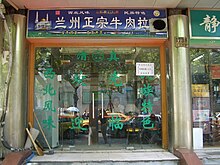
Small restaurants serving Lanzhou-style lamian are very mutual throughout Western China where they have formed a staple diet for centuries, likewise every bit Eastern Chinese cities. They tend to serve a variety of low toll meals, with a pick of lamian, pocketknife-cut noodles and perhaps 11'an-style paomo (steamed bread dipped in soup). Noodles may exist served with beefiness or mutton, either in soup or stir-fried. Lamian can also be served cold with salad ingredients such as shredded cucumber and tomato plant to brand a refreshing summer dish.
Most of the lamian restaurants in Prc are owned by Hui ethnic families from Northwestern China[two] and serve but halal food (thus no pork dishes). Lamian restaurants are the most mutual halal restaurants in Eastern People's republic of china.
Some other typical diverseness of lamian is Shandong lamian, from the eastern province of Shandong.
Singapore [edit]
Singapore sports 'lamian' restaurants, all the same the taste may exist alien to those accustomed to Chinese lanzhou lamian, as the ingredients are often altered to adapt local tastes which are distinctly Southward-Eastern Chinese. There are however lamian restaurants in Singapore serving tastes like if non identical to lanzhou lamian, particularly if run past Chinese migrants.
United States [edit]
In New York'southward Manhattan and Sunset Park Chinatowns, lamian restaurants are a common sight. Most are run by Fuzhounese, some featuring knife-cut noodles, but near featuring simply the mitt-cut versions. In Manhattan Chinatown, almost are located in the Fuzhounese area of Chinatown east of Bowery, while in Sunset Park, erstwhile referred to equally Fuzhou Town, they are scattered along the 8th Avenue strip.
Commonwealth of australia [edit]

Lamian restaurants are increasingly found in Australia's Chinatowns and beyond. Near are run by non-Hui, non-Muslim Chinese migrants from mainland China and therefore differ from the typical Muslim 'lamian' restaurants in Communist china, as the meat will not be halal and ingredients such every bit pork are offered. Whilst in China lamian restaurants are typically inexpensive in comparison to other local food, in Commonwealth of australia the price of lamian eatery meals is on par with other Chinese and local nutrient varieties. Whilst in China lamian restaurants are advertised as 'Lanzhou' lamian, regardless of whether the recipes and staff are from Lanzhou, in Australia 1 finds non-Lanzhou lamian advertised, such every bit Xi'an lamian and Xinjiang lamian.
Philippines [edit]
Manila, Cebu and Davao'due south Chinatowns take Chinese restaurants serving lamian. Additionally, the Filipino version of noodles, locally called Pancit Canton, is a popular Filipino dish.
Deutschland [edit]
Munich and Frankfurt am Master have Chinese restaurants specialized in serving lamian, located near their respective main train stations.[iii]
See also [edit]
 | Wikimedia Commons has media related to Lamian. |
- Chinese noodles
- Lo mein
- Laghman
- Ramen
Footnotes [edit]
- ^ a b c d Serventi, Silvano; Sabban, Francoise (2000). Pasta: The story of a universal food . Translated by Shugaar, Antony. New York: Columbia University Press. pp. 334, 337. ISBN978-0-231-12442-3.
- ^ Gladney, Dru C. (1996). Muslim Chinese: Ethnic Nationalism in the People's Democracy (2 ed.). pp. 171–173. ISBN0-674-59497-five.
- ^ "Nudelsuppen und Dumplings im Gallus - Aunty Zhongs Noodle Bar & More".
Source: https://en.wikipedia.org/wiki/Lamian
0 Response to "Beef Hand Pull Noodle Soup China Station"
Post a Comment